 COMPLETION RATE FROM
SCHOOLS IN HAMBURG
The completion rate is directly tied
to a specific societal background.
______________________________________________________________________________________________________________________________________________________________________________________
General information
Education and its pursuit has an essential value within our modern society. To raise the informed and enlightened leaders of tomorrow, which are capable of critical and innovative thinking, should be a guiding principle for every country worldwide.
To this end, the United Nations (UN) sustainable development goal 4, Quality Education, aims to ensure inclusive and equitable quality education and promote lifelong learning opportunities for all. Sustainable development goal 4 itself is divided into up to ten individual development targets. The following study is focused on developement target 4.1 which states that by 2030, it is to ensure that all girls and boys have access to complete free, equitable and quality primary and secondary education leading to relevant and effective learning outcomes. Every development target is monitored by different international indicators and their associated national subindicators. Within the context of this study the indicator 4.1.2 Completion rate, directly tied to SDG Target 4.1, concerning primary, lower secondary and upper secondary education, will be more closely evaluated. The adjacent national subindicator for our target country of Germany would be indicator 4.1.a, which concerns the completion rate of students in the early stages of their educational development.
SDG 4 Evaluation for Germany
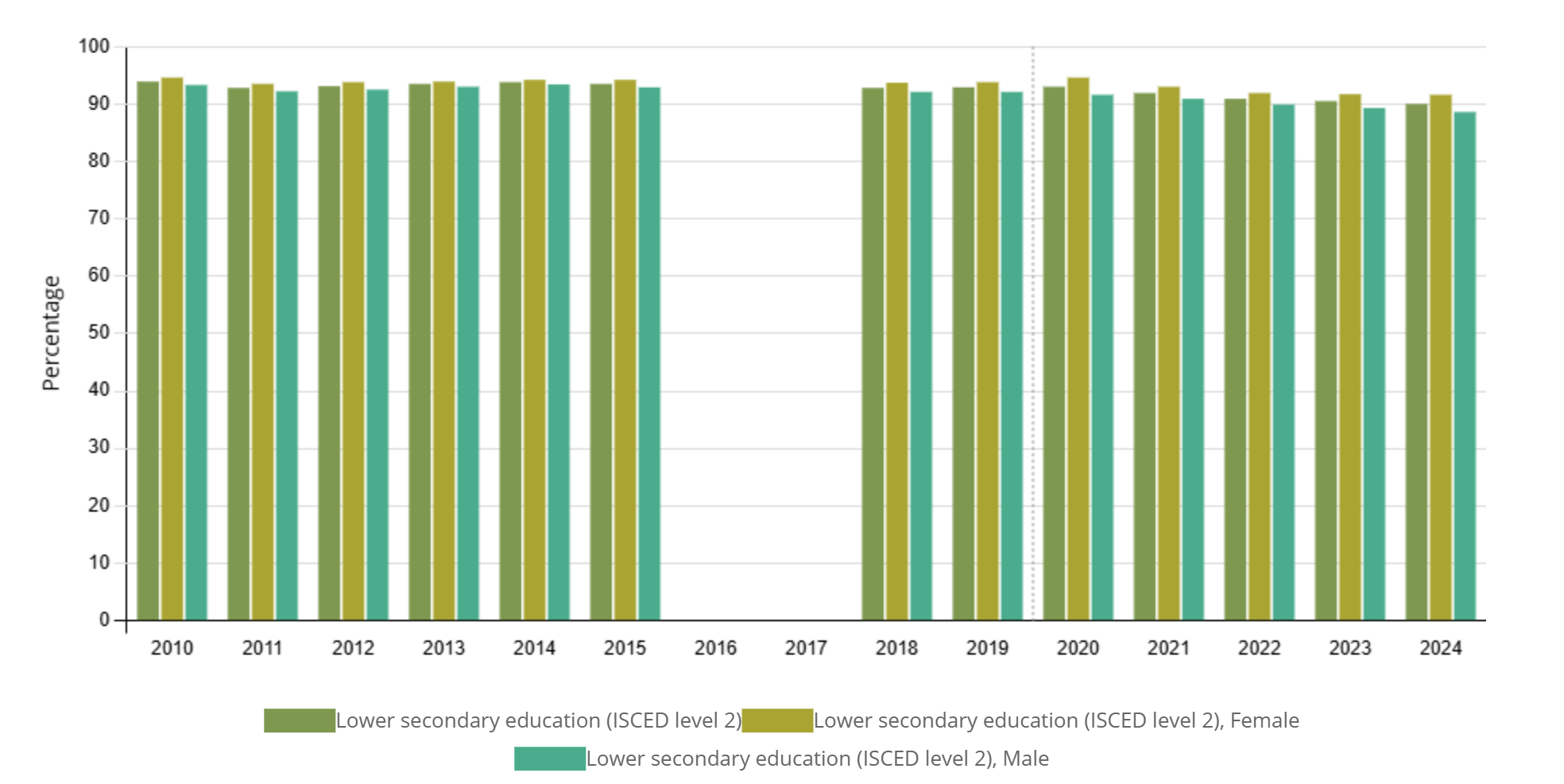
Completion rates for the lower secondary education
Completion rates for the upper seconday education
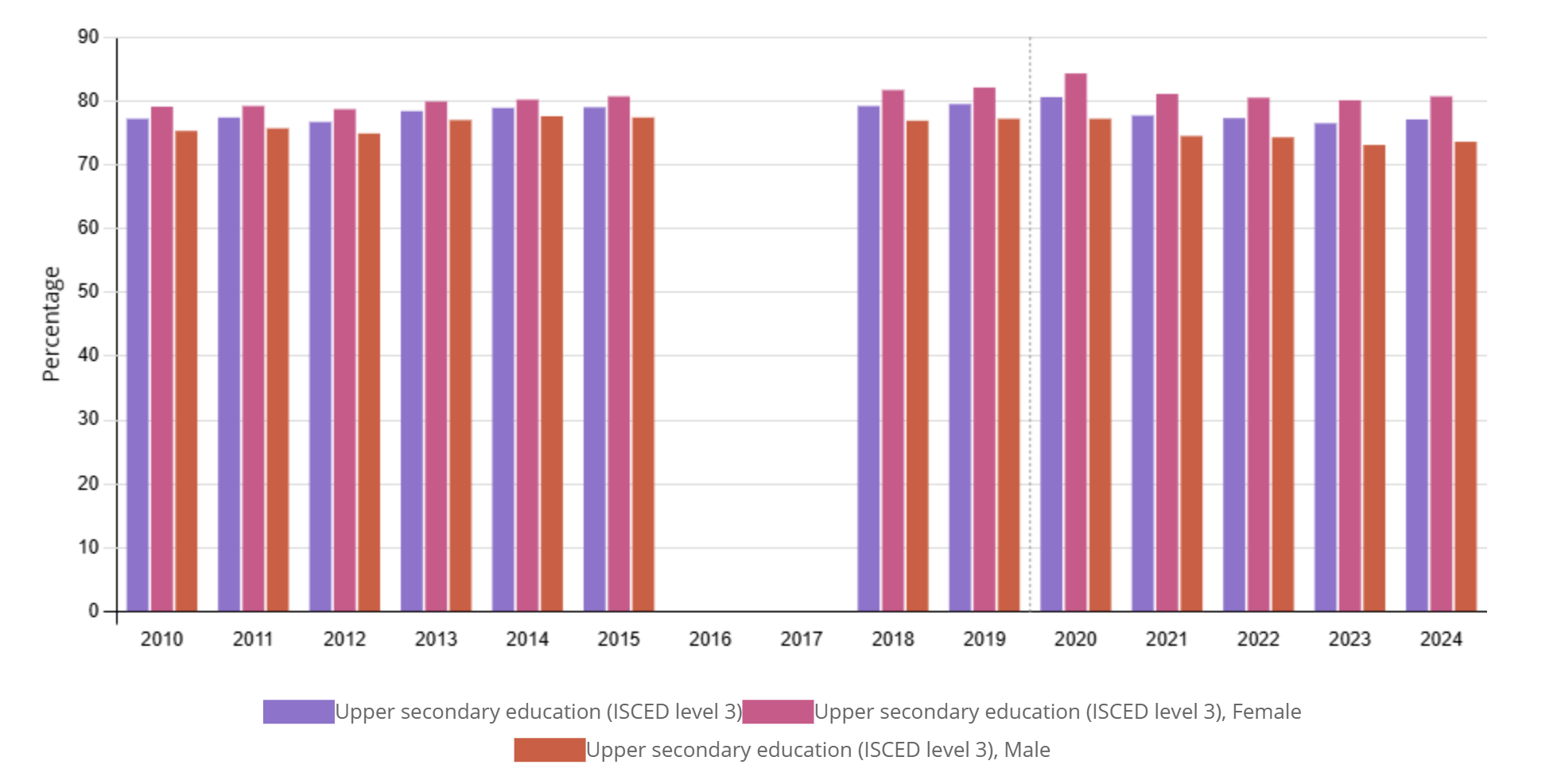
Based on the data the federal statistical office provided, it is evidently that educational standards, at least for the lower levels of education, can be interpreted as high concerning the country of Germany.
There is no further information on how this data was collected. All persons who have at least one qualification from the ISCED levels are recorded. Possible gaps within the data provided by the federal statistical office (destatis) are due to undisclosed information pertaining to the corresponding year of the relevant survey or unknown numerical value of said data concerning specific time periods.
______________________________________________________________________________________________________________________________________________________________________________________
SDG 4 Contextualization for the City of Hamburg
Representative for the country of Germany, the city of Hamburg functions as an example sample in the context of this research study. Prominent data sources for the educational standards and the educational landscape of the city of Hamburg are the Hamburger Schulstatistik for the observation period 2025 to 2026, evaluating the local schools system based on a number of different factors, and also the Sozialmonitoring-Bericht 2025, whichs aims to identify districts and certain areas of the city, which are in need of financial and social development measures.
While the UN data clearly shows the adequacy of Germanys educational infrastructure on a countrywide scale, data pertaining to local conditions can depict a different situation. All school types represented in the following study are covered by the ISCED educational levels used in the context of the UN statitics.
Chart 1, based on the Schulstatistik, shows that specific school forms in the City of Hamburg suffer from lower completion rates and lower graduation numbers. These are Stadtteilschulen, which are specific to the city of Hamburg, Gymnasien and Sonderschulen. For further information on these specific school types and their role within the context of the german educational system, consult the glossary also included on this webpage. The ReBBZ (Regionales Bildungs- und Beratungszentrum), while also reporting a significant number of students without a graduation, will be excluded within the context of the further analysis. This is due to key structural differences in comparison to the other, more ordinary, school types. Map 1 shows where these specific school types are located on a citywide scale. When compared more closely, it becomes evidently that Stadtteilschulen not only received the highest number of students in the given year, they also reported the highest number of students leaving the school without an official degree, which seems plausible. 54 % of the total number of students in Hamburg are registered in Stadtteilschulen. 8.5 % of these students leave the school without graduating. This number seems low at first, but put in perspective there are almost 850 children and teenagers which are failing school and could therefore suffer from disadvantages in many of the vocational fields.
School locations in Hamburg
This is an interactive map, which shows different types of schools in Hamburg (Stadtteilschulen, Gymnasien, and Sonderschulen) and their respective locations. If you click on any school icon, you will see the type of school.
The data the Hamburger Sozialmonitoring provides, shows that completion rates are lower or lowest within the eastern and the southern districts of the city (Page 25, Map 19), which correlates with the data provide through Map 1 concerning the localisation of the previously identified school types. Coincidently the Sozialmonitoring-Bericht also indicates that these districts have the highest amount of children and teenagers with an immigrational history and background (Page 18, Map 12).
Students in Hamburg leaving school without graduating
This interactive map shows the distribution of students in Hamburg who are leaving school without graduating. Go with your cursor on any district and see the number of students. The grey districts contain no information.
Based on this data, one could assume a direct connection between aspects of the societal background of children and teenagers, which in this case would concern their country of origin and their native language, and their graduation rate.
Chart 2 shows that the amount of students whose native language is not german is the highest in Stadtteilschulen, which is one of the types of schools which reported lower completion rates in 2024/25 (see Chart 1).
This is supported by the data contextulized in Chart 3, which shows an identical proportion concerning students without german citizenship. This evaluation could lead to the assumption that possible language barriers inhibit the likelyhood of an successful graduation, especially from specific types of schools.
It is important to note that, while they can be one of the important factors inciting lower graduations rates, that country of origin and ones native language are not the definitive and not the only reason for these developments. The accessible data provides a noticeable and plausible correlation between these topics but fails to support their integration into a broader context.
______________________________________________________________________________________________________________________________________________________________________________________
More data needed...
The country of origin and ones native language can not be definitely assumed as the only reasons for lower graduation rates. The flaws of the predicted correlation within the evaluated data originates partially in the lack of more data with could support the claims this study presents. Following datasets could provide more insights concerning the ties between education and the societal background.
For an extensive analysis, several socioeconomic and education-related data sources could be useful in futher addition. These include the living situation of families, such as the districts they live in and the average number of people per household. Also, the income level of each area is important, as it could provide insight into financial resources and potential educational disadvantages. The unemployment rate should also be considered to better assess the overall economic conditions of the regions.
Another key factor is the parents' level of education as well as the rate of single-parent households, since these aspects can significantly influence the level of academic support available at home. The data for the parents' level of education is nearly impossible to collect, because in the case of immigrated parents, the information is often incomplete or unavailable. None or not all of the above mentioned additional datasets could be tied to a immigrational background. But especially the factors concerning living or income situation are more likely to be the most challenging for immigrants and their families. Furthermore, absenteeism among students and teachers should be analyzed to identify its possible impact on learning outcomes. This data is also not available or does not exist for public access. Lastly, access to support systems such as tutoring, language assistance, and other educational programs is a big part of the problem, as these resources can play an important role in improving academic performance and reducing inequality. But in reality, most students do not recieve any support, because of the financial resources.
While these additional datasets would be helpful in refining this cases underlying statement, most of the possible data can not be traced back to a possible source viable for integration within this study itself, while other possible sources are not publicly available and their viabilitly can only be speculated upon.
______________________________________________________________________________________________________________________________________________________________________________________
Theoretical background
Educational attainment is not alone determined by individual ability or academic performance. A substantial body of research shows that students' educational opportunities and outcomes are associated with their social background. Factors such as parental education, household income, socioeconomic status, and the social environment in which children grow up can influence educational pathways and the likelihood of obtaining higher school-leaving qualifications. The 2026 national education report Bildung in Deutschland identifies educational inequalities according to social background as a major issue and examines the mechanisms through which inequalities emerge and persist throughout the educational pathway.
In Germany, social inequalities in education are particularly relevant because educational attainment is strongly connected to social origin. Research by Blossfeld (2020) shows that inequalities in educational opportunities between different social-origin groups have remained relatively stable across generations, despite substantial educational expansion and reforms. This suggests that an expansion of educational opportunities does not necessarily eliminate differences associated with students' social backgrounds.
The relationship between social background and educational outcomes can also be observed at the regional and school level. In Hamburg, the Institute for Educational Monitoring and Quality Development (IfBQ) uses a Social Index to describe the socioeconomic composition of the student population at schools. The index ranges from 1, representing schools whose students predominantly come from more disadvantaged socioeconomic backgrounds, to 6, representing schools with more privileged socioeconomic backgrounds. The index is based on official school data and regional structural data and is used, among other purposes, to support a needs-based allocation of resources to schools.
Recent data from Hamburg further demonstrates differences in the social composition of students across school types. According to the IfBQ, students at Gymnasien are more likely to come from areas with a higher social status, whereas students at Stadtteilschulen are more frequently represented in areas with lower social status. These differences indicate that educational pathways in Hamburg are socially differentiated and that students' social environments are related to the types of schools they attend.
Based on this theoretical and empirical background, the present project examines the relationship between social background and school-leaving qualifications in Hamburg. Rather than assuming a direct causal relationship, the analysis investigates whether differences in social background are associated with differences in educational attainment. By presenting the available data through interactive charts and maps, the project aims to make existing patterns of educational inequality in Hamburg more accessible and easier to explore. The final goal should be the alignment of local and national educational standards, so that local realities reflect the findings of the national evaluation, done within the context of the sustainable development measurements of the UN.
______________________________________________________________________________________________________________________________________________________________________________________
Conclusion and Outlook
Besides the possiblity of more data, which could help to broaden the scope on the societal background of young individuals and its ties to their educational pathways, the existing data shown in this study offers a specific point of view and with that a direct goal on how to invest in Hamburgs current educational system. As the data indicates, the higher the educational level of a specific type of school, the higher the graduation rate. Meanwhile, the highest number of non-german native speakers or students without german citizenship can be traced back to the lower ranked types of schools. This gap between the different types of schools needs to be closed or at least more closely aligned so that higher graduation rates for lower level educational institutions can be achieved. The possible additional data, found within the processes of the educational system which are not public, could be the key to identifying the specific areas inside the system where different stakeholders need to act to reach this goal.
Stakeholders
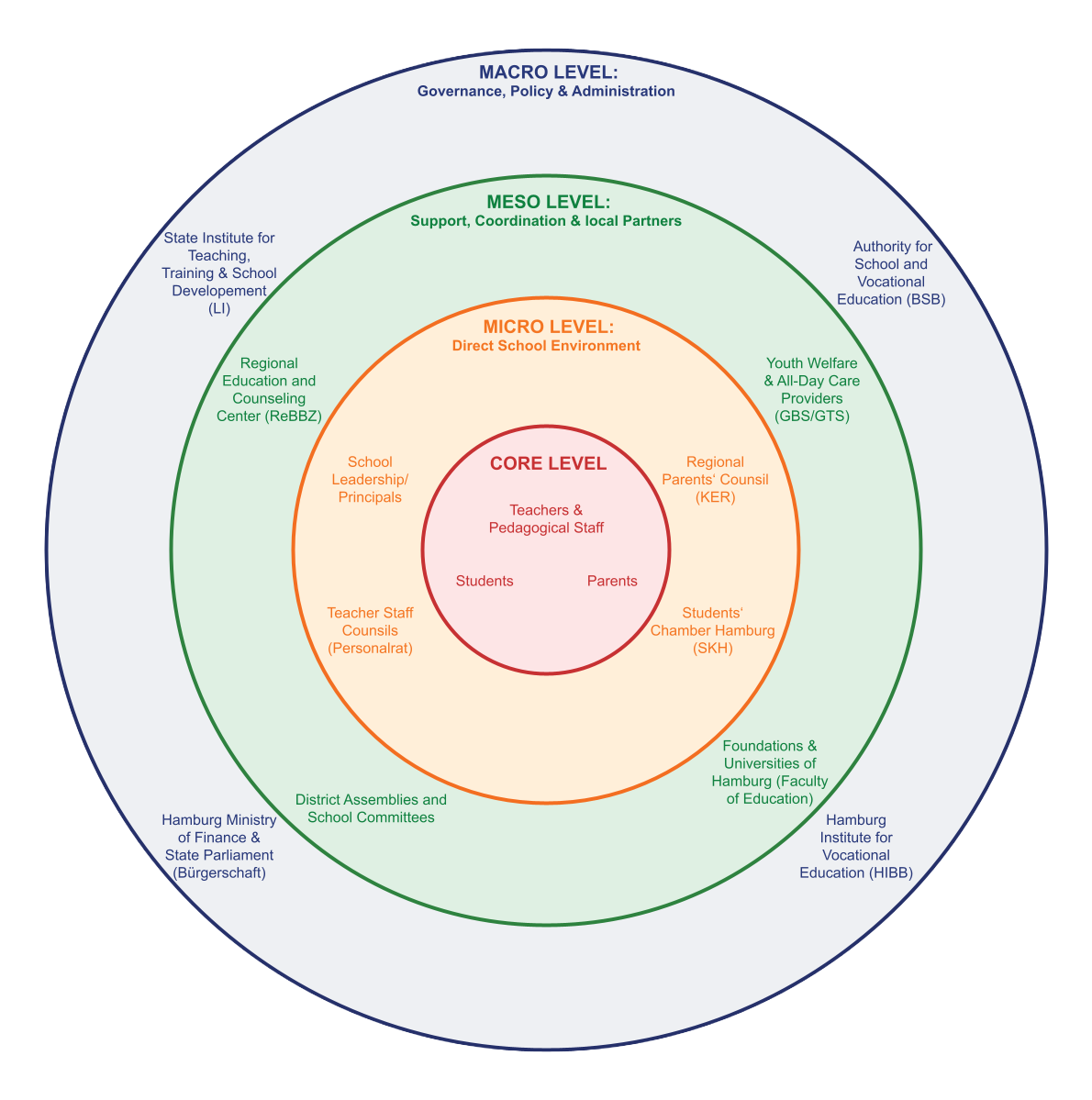
Based on this study, measurements for supporting different language groups could be enhanced for the specific types of schools, which were pointed out previously, especially for Stadtteilschulen. General integrative and inclusive developments should be further supported within these specific institutions. Financial measurements are also crucial in this context. To this end, all relevant stakeholders within the educational landscape in the city of Hamburg must be part of any measurements for improvement. This is especially the case for any stakeholders within the core and micro levels of the educational system. The students, their parents and teachers and also the institutions reprententing these groups in the direct school environment must be included in any plans for future development because they are the most affected by the outcomes of these changes. Concering the topic of financial support and groundlevel structural changes within the educational systems, it is essential that stakeholders from the macro level are properly integrated into these developments processes aswell. For example the Hamburg Ministry of Finance and the State Parliament (Bürgerschaft) reprensent the highest manifestation of governance in the city and need to be convinced in investing in a future sustainable education system.
The final goal for supporting a citywide equitable educational system should be the alignment of local and national educational standards, so that local realities reflect the findings of the national evaluation, done within the context of the sustainable development measurements of the UN.
______________________________________________________________________________________________________________________________________________________________________________________
METHODS
METHODS
Glossary: To ensure accessibility and minimize potential language barriers, a glossary was integrated into the webpage. German terms used throughout the work are linked to corresponding explanations in the glossary.
Data Visualization: The interactive charts and maps were created using Datawrapper. Predefined templates were used to ensure a consistent visual presentation of the data. The colors were individually selected to match the overall design of the webpage. The current color palette (diverging/bi-polar scheme: red, blue) for the second map was chosen to present the lowest (blue) and highest (red) values. According to Schiewe (2025), red is associated with high or bad values and blue with small or negative values.
Webpage Design: The design of the webpage is based on the colors of the Hamburg flag, using red and white to create a consistent visual appearance. The layout was designed to be simple and easy to navigate, with clear headings and sections for each topic. Images, interactive charts, and maps were integrated to support the presentation and visualization of the content.
Data Sources: The used data sets were all completely provided by the different sources. No data set was collected, created or edited by the authors of this webpage.
Text: For translation and wording purposes www.deepl.com, www.chatgpt.com, and www.gemini.google.com were used.
GLOSSARY
GLOSSARY
UN STATISTICS
ISCED Level 2 (Lower Secondary Education): The level of education that builds on primary education to complete basic learning. Often serves as the benchmark for achieving universal completion of basic education and proficiency in reading and mathematics.
ISCED Level 3 (Upper Secondary Education): The final stage of secondary education designed to prepare students either for even higher education, technical or vocational training, or direct entry into the labor market (ages 15-18). Used to measure progress toward equal access to relevant learning outcomes, technical skills, and career-readiness before adulthood.
SCHOOL TYPES AND EDUCATIONAL PATHWAYS
Stadtteilschule: A comprehensive secondary school unique to Hamburg (grades 5-13). It combines lower, intermediate, and upper secondary educational levels. Students can achieve all types of degrees, including the Abitur after 13 years, moving at their own pace.
Doppeltqualifizierender Bildungsgang: A dual-qualification pathway. It allows students at vocational schools or specific upper secondary educational paths to simultaneously obtain a higher school-leaving certificate and a fully recognized vocational or professional qualification.
Gymnasium: A university-adjacent secondary school (usually grades 5-12 in Hamburg). It offers an intensified academic curriculum designed to prepare students for higher education, culminating in the Abitur examination.
Rudolf-Steiner-Schule: An independent private school based on the Waldorf educational system. It emphasizes holistic, creative, and practical learning without traditional grading systems until the upper grades, covering years 1 to 13.
ReBBZ (Regionales Bildungs- und Beratungszentrum): A regional Education and Counseling Center. A Hamburg-specific institution providing psychological, educational, and logistical support for students with special educational needs, their parents, and teachers. It often includes a specialized school section.
Sonderschule: A special education school tailored for children with physical, mental, or emotional disabilities or learning difficulties who require specialized pedagogical support outside the mainstream school system.
Berufsfachschule: A full-time vocational school. Unlike a dual system, this school provides complete vocational training or prepares students for specific professions completely within an academic setting.
Abendschule / Abendgymnasium / Hansa-Kolleg: Institutions for adult education. Abendschule and Abendgymnasium offer evening classes for working adults to earn intermediate certificates or the Abitur. The Hansa-Kolleg is a state-run institute offering full-time day courses for adults aiming to achieve the Abitur.
Nicht-Schüler-Prüfung: An external student examination. It allows individuals who did not attend a traditional school (or left early) to take the official state exams independently to obtain a school-leaving certificate.
CERTIFICATES AND DEGREES
Ohne Schulabschluss: Leaving school without a formal qualification. This applies to students who drop out or fail to meet the minimum requirements of the lowest graduation tier.
Erster allgemeinbildender Schulabschluss (ESA): First general graduation certificate. Typically obtained after grade 9, it qualifies students to start a vocational apprenticeship in the dual system.
Erweiterter erster allgemeinbildender Schulabschluss (erweiterter ESA): Extended first general school certificate. Awarded after grade 9 or 10 with higher grades than a standard ESA, often serving as a bridge to enter intermediate vocational tracks or higher school forms.
Mittlerer Schulabschluss (MSA): Intermediate school-leaving certificate. Obtained after grade 10, it confirms a solid level of general education and qualifies students for advanced vocational training or entry into upper secondary school.
Schulischer Teil der Fachhochschulreife: The academic component of the advanced technical college entrance qualification. It is achieved by successfully completing the specialized coursework of grade 11 or 12, but requires a subsequent practical internship or apprenticeship to become fully valid.
Fachhochschulreife: Advanced technical college entrance qualification (often called Fachabitur). It combines academic coursework with practical experience, qualifying the holder to study at any University of Applied Sciences (Fachhochschule).
Allgemeine Hochschulreife: General university entrance qualification (commonly known as the Abitur). The highest secondary school diploma in Germany, typically achieved after grade 12 or 13, granting the right to study any subject at any university or higher education institution.
SOURCES AND REFERENCES
SOURCES AND REFERENCES
Hamburger Schulstatistik 2025/26, Statistisches Amt für Hamburg und Schleswig-Holstein, 2025
Sozialmonitoring-Bericht 2025, Statistisches Amt für Hamburg und Schleswig-Holstein, 2025
Sustainable Development Goals, United Nations, 2015
Statistisches Bundesamt (destatis)
https://sdgs.un.org/goals/goal4
https://geoportal-hamburg.de/?lng=de
https://www.bildungsbericht.de/de/bildungsberichte-seit-2006/bildungsbericht-2026
Blossfeld, P. N. (2020). The role of the changing social background composition for changes in inequality of educational opportunity: An analysis of the process of educational expansion in Germany 1950-2010. Advances in Life Course Research, 44, 100338.
https://ifbq.hamburg.de/bildungsberichte-und-statistische-analysen/sozialindex
https://ifbq.hamburg.de/2026/02/10/soziale-herkunft-der-schuelerschaft-der-verschiedenen-schulformen
Schiewe, Jochen (2025). Cartography: Visualization of Geospatial Data. Springer, Berlin, Heidelberg. ISBN 978-3-031-83022-8
Landesinstitut für Qualifizierung und Qualitätsentwicklung in Schulen (LI Hamburg): https://li.hamburg.de
Behörde für Schule, Familie und Berufsbildung (BSB): https://www.hamburg.de/politik-und-verwaltung/behoerden/bsfb
Hamburgische Bürgerschaft: https://hamburgische-buergerschaft.de
Hamburger Institut für Berufliche Bildung (HIBB): https://hibb.hamburg.de
Regionale Bildungs- und Beratungszentren Hamburg (ReBBZ): https://www.hamburg.de/politik-und-verwaltung/behoerden/bsfb/einrichtungen-beratung/rebbz-info-118442
Kreiselternrat der Elternkammer Hamburg (KER): https://www.elternkammer-hamburg.de/kreiselternrat/
Schülerkammer Hamburg (SKH): https://www.skh.de