by Mara Fathy, Hanbaek Park & Meret Dorner
Dangerous Cycling
Identifying Hidden Risks for Biking

Car dominance is leading to high accident rates among cyclists resulting in less casual usage of bikes as an alternative to automobile mobility. As it is dangeous to ride a bike, not only does it affects the use of bicycles but also pedestrians as it increases more cars on the road. Reclaiming traffic space more friendly to bicycles will help reduce the problem of traffic congestions, motivate more environment-friendly modes of transportation. The recent results of the survey from the Allgemeine Deutsche Farad-Club e.V.(ADFC) shows a disappointing result for the bicycle situation in Hamburg. Thousands in Germany were asked if they enjoy cycling and if they feel save doing so in their city, with 27 questions regarding safety and comfort for cycling, infrastructure, traffic and subjective satisfaction on the road. Especially for infrastructure and traffic safety the results for Hamburg were very low, showing that 77% of the respondents perceive biking as dangerous and only few consider it fun. In comparison in the prevailing city Bremen there were 66% of participants enjoying biking due to the amount of „Fahrradstraßen“ in the city. The project „ProBike-HH“ is looking for solutions to rise bike traffic and render it more attractive. Mainactors for the project is the Hansestadt Hamburg and the TU Dresden, who are aiming to accelerate bike traffic by digital solutions, minimize waiting periods and introduce an intelligent information guidance. Therefore they introduced a new Informationssystem for cyclists to avoid waiting periods at red traffic lights, aiming at a „Grüne Welle“ for cyclists, and upgrade the counting stations for bike traffic. However we think that not only the speed is relevant for rising the general content of cyclist. A priority over car lanes, more spaces and clear indications can improve the feeling of safety on the bike considerably. This could lead to more people using the bike in everyday life in the city instead of only for leisure reasons. Thats why we want to identify safe cycling routes. Furthermore we think that children might need more protection with bike traffic and infrastructure, but once given it could give them more independence in movement in the city and teaches them how to move in traffic from an early age. This way, as adults they are already used to using the bike and obviously if routes are safe for children, they are also safe for adults.
Data-oriented Stakeholder Analysis
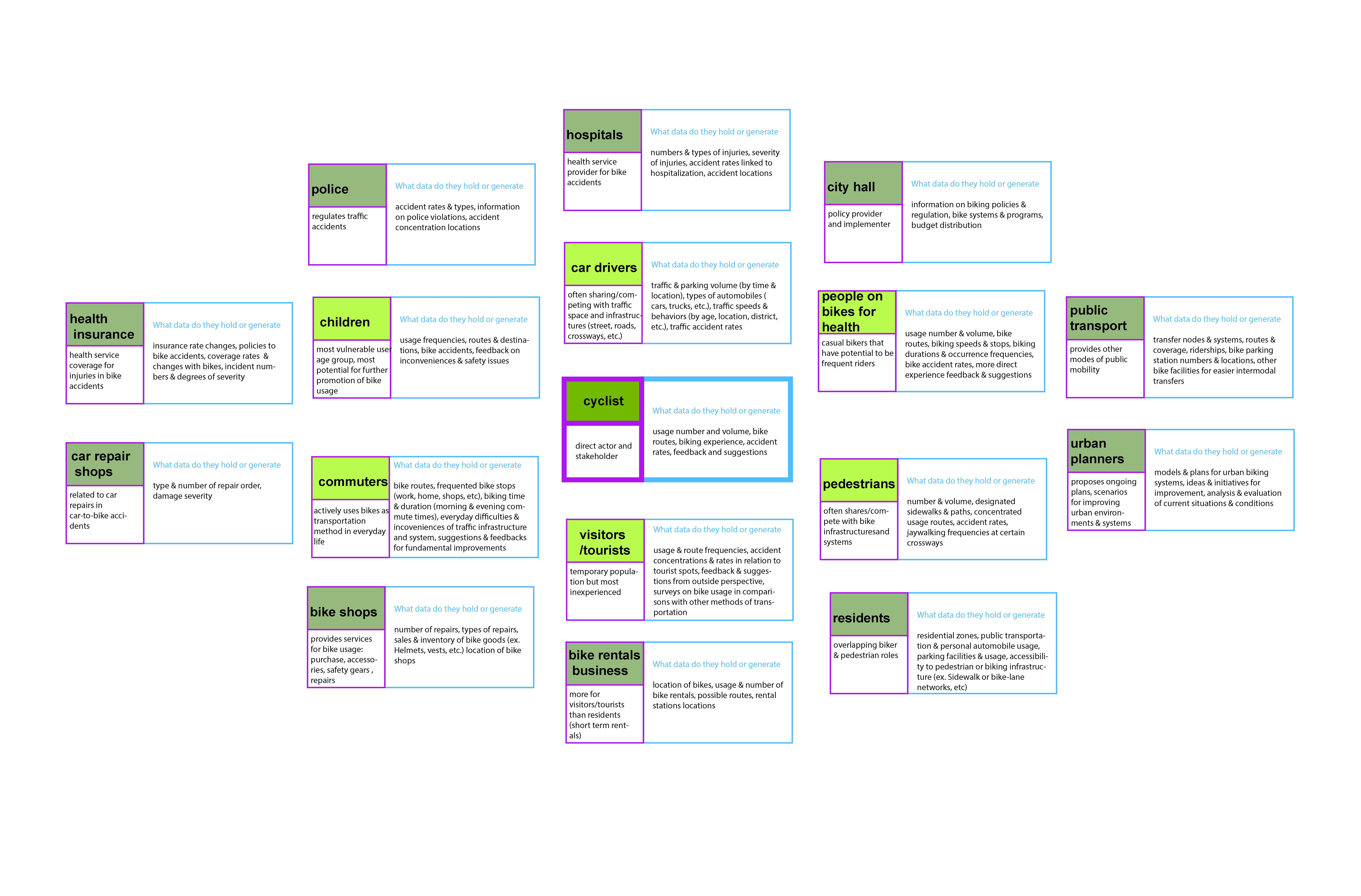
The Stakeholder analysis aims to identify key groups and their involvement for the problem statement. The cyclists in the center can be seen as the primary users and therefore build the core stakeholder. Next there are the direct stakeholders, who interact closely with the core group and are affected by the stated problem. The last level are the indirect stakeholders, which are more peripherally involved but still provide relevant data for mobility planning and traffic or accident rates.
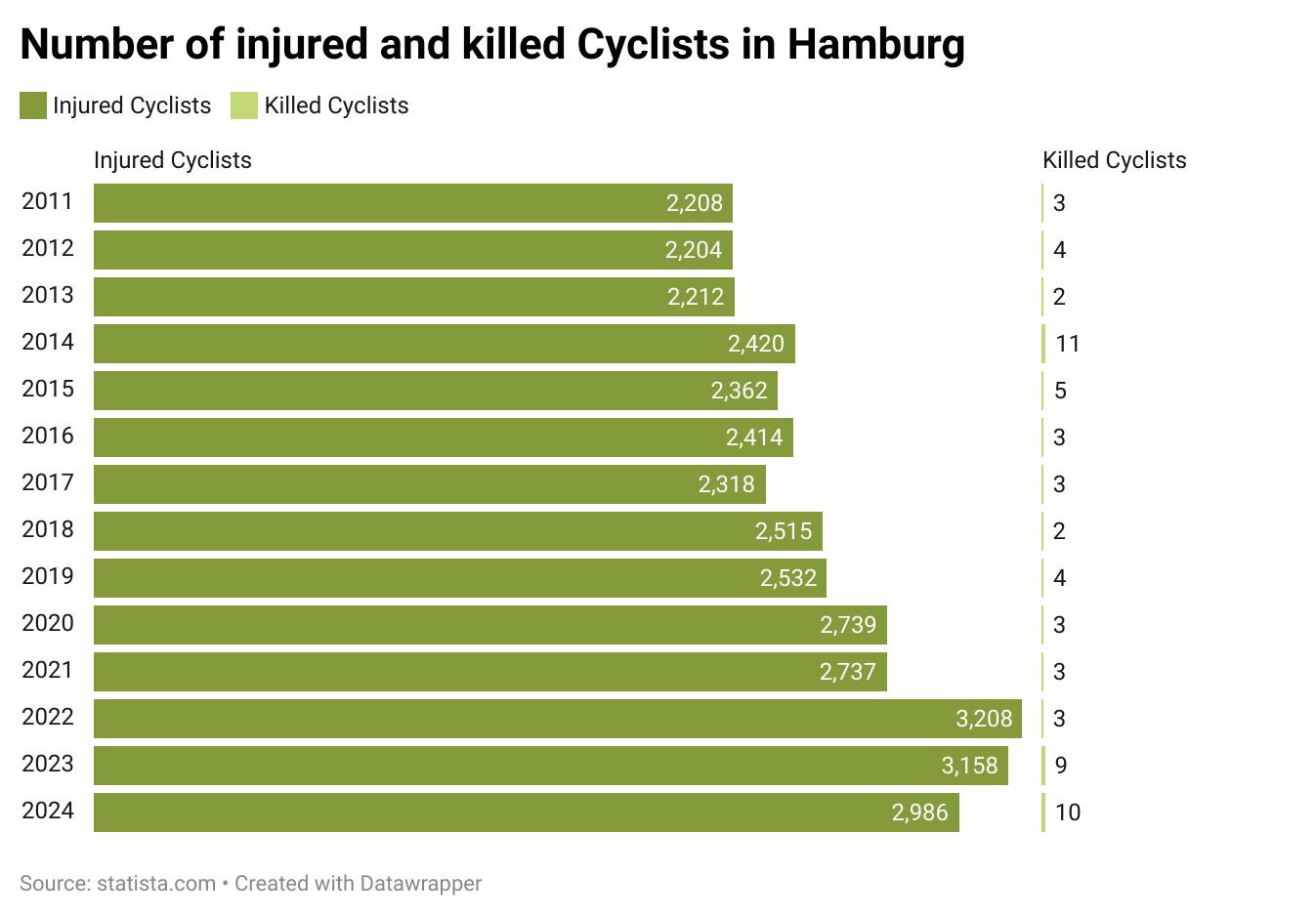
As the data visualization shows the number of cyclist who got killed during an accident increased over the last 14 years. The number of cyclists who got injured in traffic also constantly increased until 2022 but are declining a bit during the last two years. The data show that there is a greater need for action to make cycle paths in Hamburg safer.
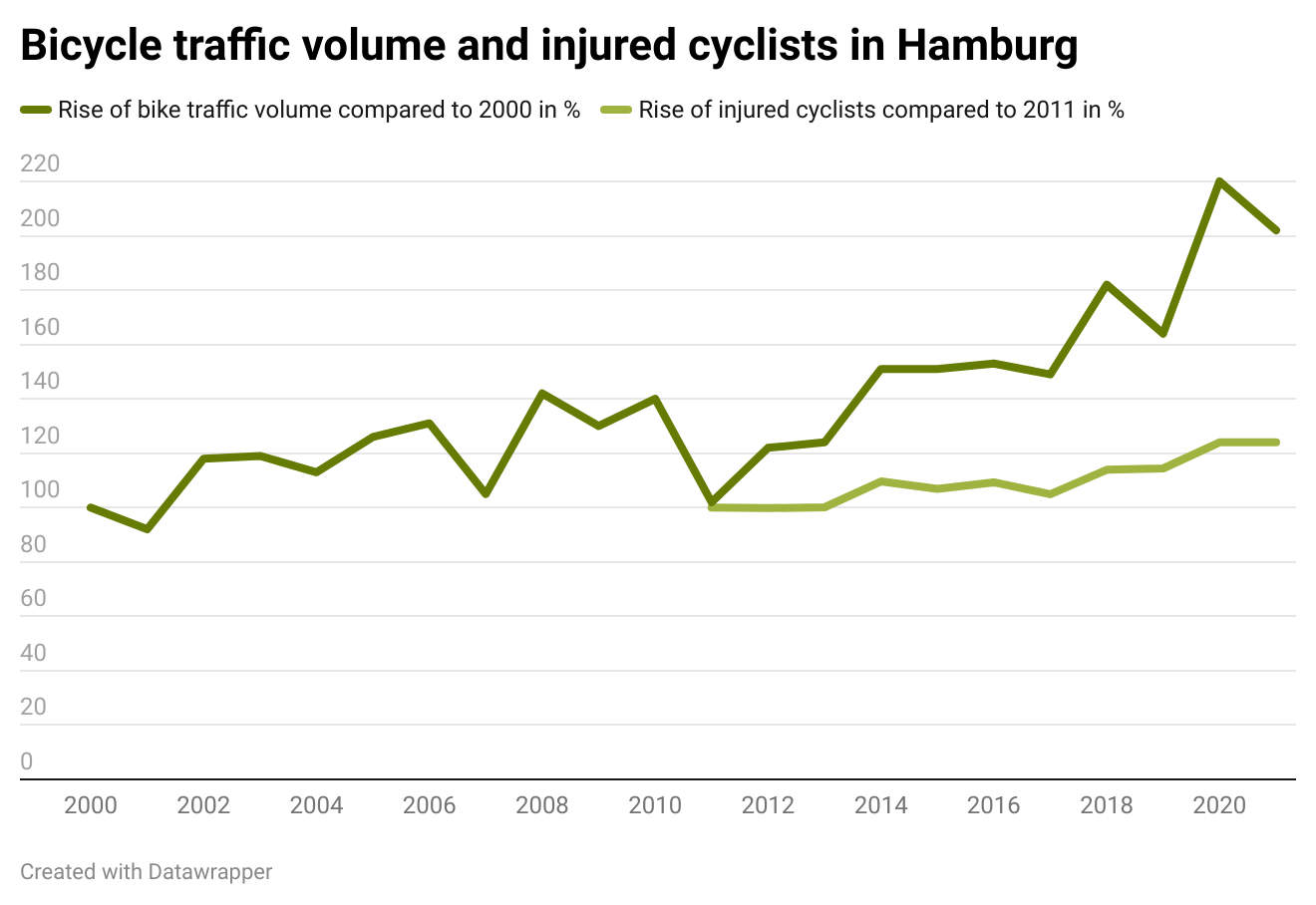
The graph shows that there is an increase in bicycle traffic since 2000. Data collected of injured cyclist since 2011 show that there is no proportional increase between the two graphs, probably thanks to the growing infrastructure for bikes like designated lanes and Fahrradstraßen. However a further improvement of the inner-city bicycle infrastructure could help to actually decrease accidents and make cycling safer and thereby motivating more people to start to discover Hamburg by bike.
Bike Lanes and Biking Facilities in Hamburg 2024
The following map shows all "Fahhradschutzstreifen" (protected bike lanes), "Fahrradstraßen (designated bike lanes) and all bike air-pumps and repair stations as well as all bike repair shops in Hamburg:
Air-pump Stations and Repair Shops
Places to check and repair bike conditions are crucial for biking safety, since a simple malfunction can easily lead to severe accidents. For instance, low-pressure tires or leak in the tire can cause difficulties in correctly steering the bike and thus delaying respond time and action from riding conditions. Other common problems that occur while riding regard with the chain, either being derailed from the brackets or breaking down. In these cases, a repair station or repair shop nearby is important in immediately addressing and resolving the issue. In general, bike air-pump and repair stations are not adequately distributed along the protected or designated bike lanes provided by the city. Especially, ‘self-service air-pump and repair stations (Self-Service Luft- und Reparaturstationen)’ are few and sparse with only four within the city limits of Hamburg and all located on the west side of the Außenalster Lake. Enhancing not only numbers but also the equipment of existing air-pump stations could also improve the safety of biking experience and environment in the city.
Fahrradschutzstreifen
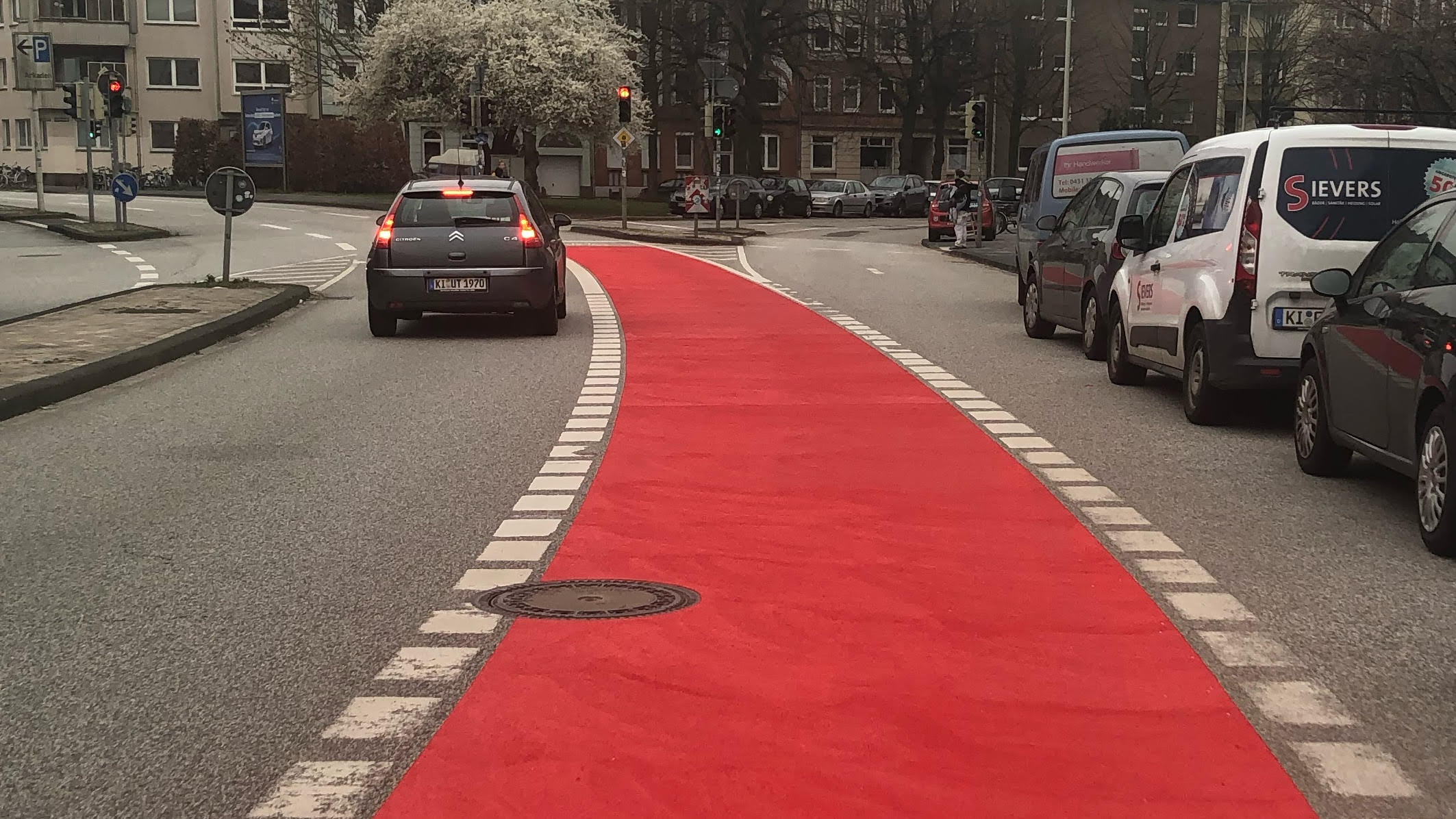
The Fahrradschutzstreifen or protected bike lane is a bike lane marked in a bright red colour or by a dashed white line on the side of a regular street. Unlike dedicated bike paths, cars are allowed to cross these lanes when necessary, such as when turning or parking, but they must not drive on them.
Fahrradstraße
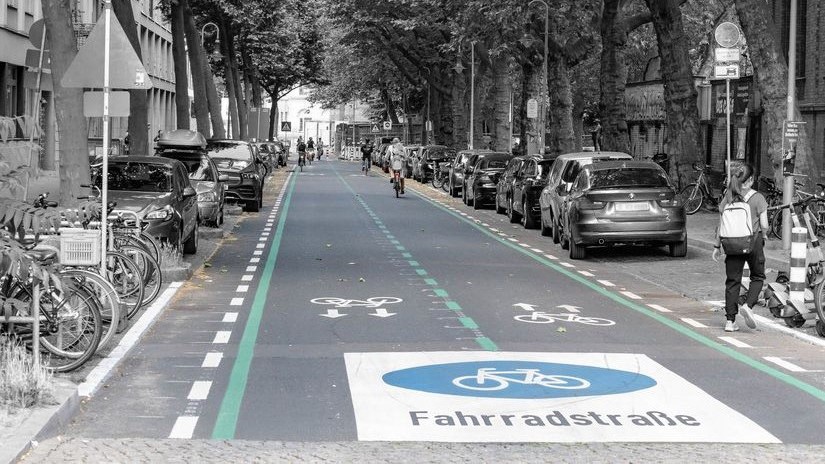
The Fahrradstraße or designated bike lanes is a street where bicycles have priority and cars are only allowed under certain conditions (recognizable by additional sign). Cyclists can ride side by side, and when cars are allowed, the speed limit is usually 30 km/h to ensure a safer environment.
Bike Lanes and Accidents in Hamburg 2024
The following map shows bicycle accident locations alongside Fahrradstraßen and Fahrradschutzstreifen in a selected area of Hamburg-Ost. It becomes clear that most accidents occur in places where there are no safety measures for cyclists:
Incomplete Bike Lane System
‘Designated (Fahrradstraßen)’ and ‘protected (Fahrradschutzstreifen)’ bike lanes have been implemented in Hamburg but yet lack a coherent and comprehensive route system. The lanes are often disconnected with short interval distances and are separated even farther apart when one moves away from the city center. Especially ‘designated bike lanes’, which should stand as the main backbones of the biking system, are barely recognized as a meaningful route only along the ‘Außeralster’ lakeside. Otherwise, they are completely dispersed throughout the city without any clear relation to other bike lanes and routes.
Protected but Cramped
The above map shows bicycle accident locations, ‘designated bike lanes (Fahrradstraßen)’, ‘protected bike lanes (Fahrradschutzstreifen)’, and all other bike lanes. The width of the bike lanes are also indicated in varying degrees of color. In general, designated bike lanes are relatively wide with fewer accidents observed. On the other hand, protected bike lanes are relatively narrow and regardless of their safety measures enforced by the city, more accidents are located in comparison to designated lanes. This implies a correlation between bike lane width and biking safety which must be prioritized when considering implementation for safer biking policies.
Wide Main Streets and Narrow Bike Lanes
Another interesting fact to note is the relation between automobile street systems and biking. Expressways, arterial streets, and main streets, of which higher traffic volume or speed is expected, actually are aligned with more narrow bike lanes (between 0.55m to 2.25m) regardless of its type or protection class level. Whereas roads of lower hierarchies, such as local streets and residential roads are in fact almost always much more wider, being in general more than 3m. Accidents are also less observed on these secondary road systems.
Biking and Children in Hamburg 2024
Biking is a quick, healthy and fun way to move around the city. However children obviously can be easier distracted and might not be as used to riding on the streets. That's why the following map shows "Fahrradschutzstreifen" (blue) and "Fahrradstraßen" (pink) and the location of Grundschulen (primary schools) and playgrounds, since they could be points of interest for children. The map clearly shows that especially the Grundschulen outside the city center are not connected with any designated bike lanes, and even in the city center the Fahrradstraßen and Fahrradschutzstreifen are not commonly located around playgrounds.
Identified Hidden Risks
“Nowhere to Repair”: Lack of nearby self-service air-pump and repair stations
“Disconnected Biking Networks”: Too few ‘designated bike lanes’ and too disparate ‘protected bike lanes’
“Cramped-up Safety”: Narrow bike lanes compromising safety and protection
“Where are the Children?”: Schools and playgrounds not fully considered for biking systems
Conclusions & Further Suggestions
On Bike Lanes & Bike Stations
1. “Need for Comprehensive & Extensive Bike Lane System”
Although Hamburg has implemented a bike lane system with varied types of lanes providing safety measures, there is much room for more improvement. ‘Designated bike lanes(Fahrradstraßen)’ with the highest level of protection by regulation could be extended and connected to create a more cohesive network system extending throughout all areas of the city. This can become the main arterial routes for biking with clearly defined demarcations and elastic pavement materials that specifically enhances bike-riding performance and experience. Secondly, ‘protected bike lanes (Fahrradschutzstreifen)’ could be the next level of connecting routes in between the main routes, for closely knitting the network together.
2. “Widen those Lanes, Please!”
However, adequate bike lane width should be prioritized foremost before any consideration and implementation for bike lane improvements. Careful and meticulous studies should be conducted beforehand in understanding the correlation between this physical condition and with other traffic variables as well. Other areas for further data analysis could include an examination on actual bike users and purpose, biking traffic volume and concentrations, differing changes of biking by time periods throughout the day and week, and the differing conditions of automobile traffic systems.
3. “More Stations for Bikes”
The city in parallel could also install and distribute more bike stations for air-pumps and easy on-site repairs, at least in the first earlier phases along the designated bike lanes, and consequently throughout all other protected bike lanes, so that not only safety while riding but also convenience for bike maintenance can be procured. These measures and implementations would as well encourage better ridership and more shift to choosing biking as an alternative mobility.
On Biking Safety & Children
“Children-centered Biking Experience”
Better connection and consideration for children spaces in the city could provide the impetus to stimulate the younger generation to use bikes as a means for transportation. Especially focusing and concentrating on providing more designated bike lanes and protected bike lanes nearby schools, playgrounds, and other frequently used children spaces could promote safe biking at much earlier age. Other street installations relating to bike riding (eg. Bike stations, bike racks, biking rest-spots, etc.) could also be provided along with educational programs for children.
Click here for the data catalogueClick here for the methodology