Overview
Despite efforts to improve public transportation infrastructure, people with disabilities continue to face significant challenges when navigating the city using buses, trains, and ferries. These challenges include the limited availability of accessible vehicles, inconsistent information on barrier-free routes, malfunctioning elevators, and insufficient staff support. As a result, individuals with mobility, visual, auditory, or cognitive impairments often experience reduced independence, longer travel times, and exclusion from full participation in urban life. Overall, there is a pressing need for a reliable and user-friendly accessibility system within public transportation to promote inclusive and equal mobility for all residents and visitors. In this study, we aim to examine how the city of Hamburg is positioned with regard to accessibility in public transportation. While Hamburg has demonstrated a commitment to improving accessibility—particularly within its bus, ferry, subway, and suburban train networks—a comprehensive, large-scale evaluation of these efforts has yet to be conducted.
Reasons for the Lack of Inclusion
The root cause of the accessibility challenges in public transport system lies in a combination of outdated infrastructure, fragmented information systems, and limited coordination between transport providers and accessibility advocates. Many transit facilities were originally designed without universal design principles in mind, resulting in physical barriers such as stairs, narrow doorways, or poorly maintained elevators. Additionally, accessibility information is often scattered across different platforms or not regularly updated, making it difficult for users to plan their journeys effectively. Insufficient training for staff on assisting passengers with disabilities further exacerbates the problem, leading to inconsistent support and uncertainty for travelers.
Why Inclusion for People with Limited Mobility Matters
In Germany, around 6.4 million people need accessible environments – whether they use a wheelchair, walker, or other mobility aids. The number of these people is still growing. Inclusion and accessibility aren't just about helping a few – they benefit everyone. Parents with strollers, elderly people, or someone with a temporary injury all gain from barrier-free spaces. With an aging population, the need for accessibility will only increase. Providing equal access is not about special treatment – it's about dignity, fairness, and equal participation in everyday life. Accessibility helps build a society where everyone belongs – now and in the future.


Accessibility Challenges: Main Areas of Concern
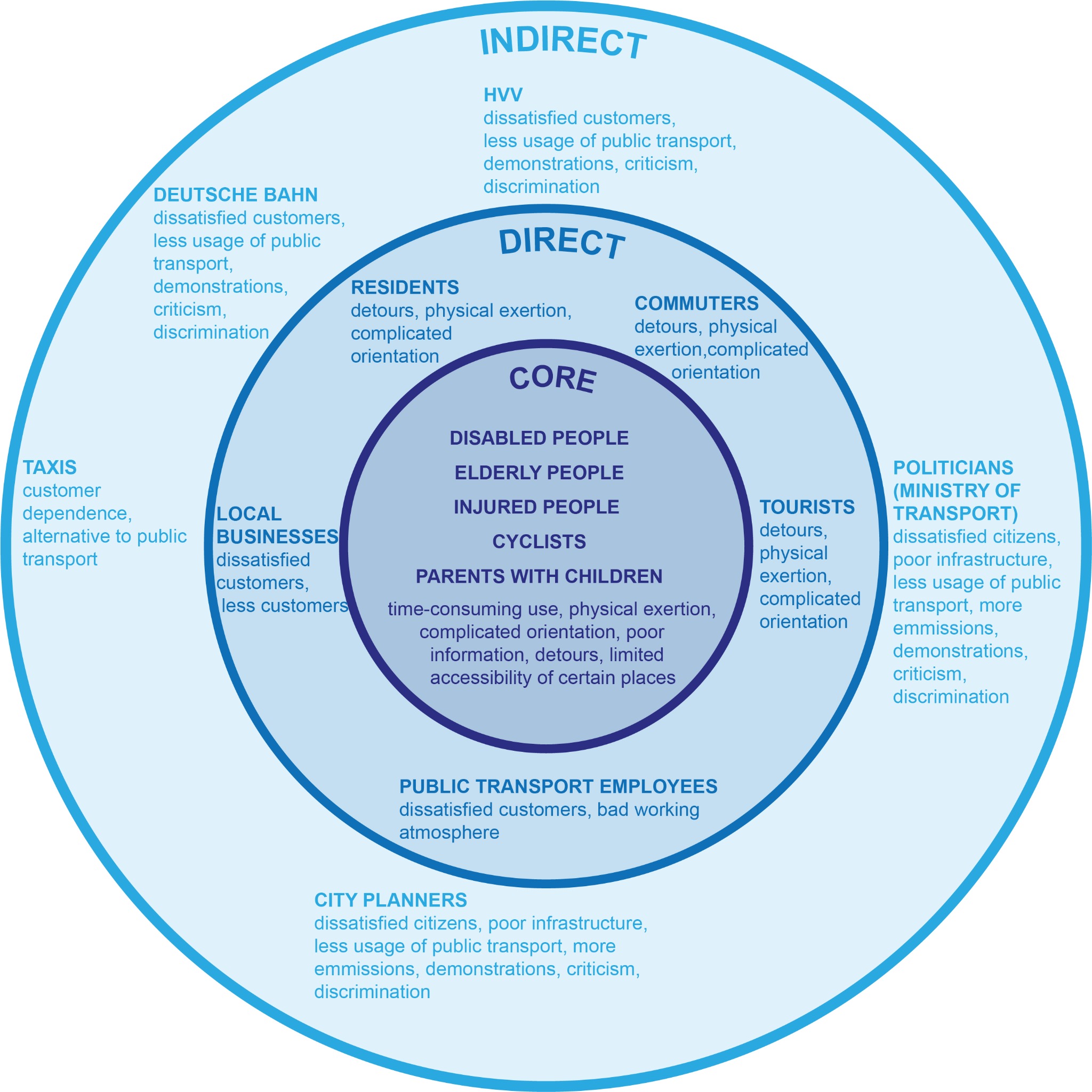
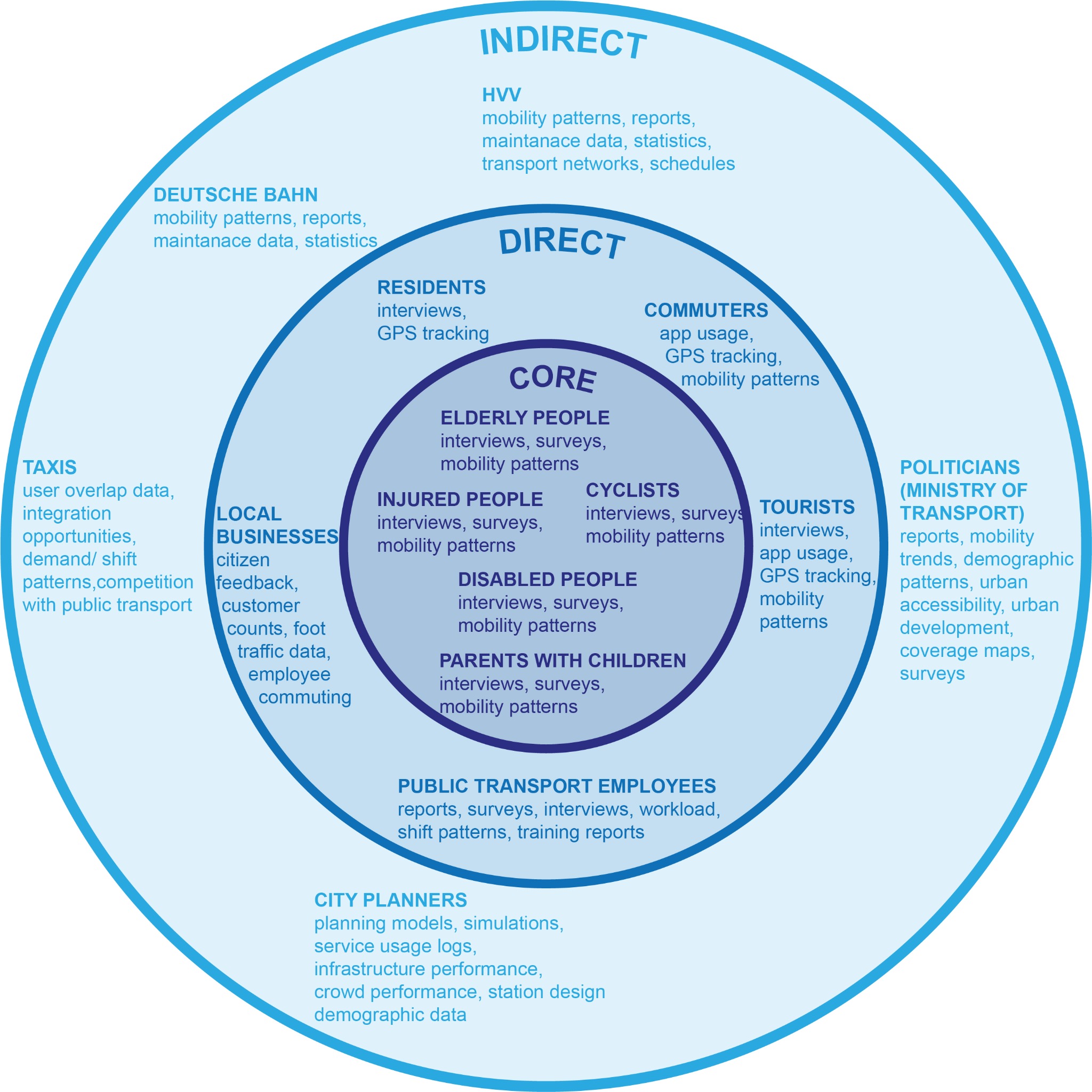
Most Important Political Problems in Hamburg in Early 2025 and Stakeholders

Access Distribution by Region
The Statista chart shows the percentage of barrier-free train stations in each German federal state — that is, stations where platforms can be reached without stairs, making them accessible to wheelchair users, people with walkers, or strollers. Hamburg has about 84% of accessible platforms. Based on the chart it’s not among the worst, but also not a leader. Despite being a large city and state in one, it lags behind states like Berlin or Schleswig-Holstein when it comes to accessibility.

Interactive Accessibility Map
This map shows all the subway stations within the Center of Hamburg. The stations are marked according to their level of accessibility for people with disabilities. Furthermore you can find the location and numbers of the accessible entrances. Green indicates that the station is fully accessible. Elevators are available, and the platform includes a raised area to allow barrier-free boarding and exiting from the train. Yellow means the station is partially accessible. Some accessibility features are present, but full access to all areas may not be guaranteed. Red marks stations that are not accessible. If you plan to travel to or from one of these stations, please consider an alternative, accessible route.
Elevator Availability & Station Features
Real-time information on elevator outages is critical for planning accessible trips. Check the live status of elevators at HVV stations:
🚇 View Elevator Status (HVV)Project Flyer: HVV – Barrierefrei unterwegs
Methods & Visualization
What methods did you use for data selection and preparation?
To select and prepare the data, we first identified the key stakeholders affected by the issue of limited accessibility in public transport. Based on this, we defined the relevant data points needed to assess accessibility in Hamburg’s public transport system. We conducted online research to find official statistics and combined publicly available datasets from OpenStreetMap and the HVV (Hamburger Verkehrsverbund). We then filtered and categorized the data, focusing specifically on S-Bahn, U-Bahn stations, and ferry terminals in Hamburg. Each location was classified according to its level of accessibility (e.g. fully accessible, partially accessible, not accessible), based on the available infrastructure such as elevators, ramps, and tactile guidance systems.
Which visualization guidelines did you use?
For visualization, we followed general accessibility and usability guidelines to ensure our website is understandable for a broad audience. This included using clear color contrasts, intuitive symbols, and consistent map markers. We chose a map-based visualization to allow users to explore accessibility geographically. The website is available in both German and English, and users can easily switch between the two languages via a language toggle, allowing broader access to the information. We also ensured that the information was structured logically and that interactive elements were screen-reader compatible where possible.
Results
The analysis reveals that Hamburg demonstrates both progress and ongoing challenges in ensuring accessibility within its public transportation system. A significant number of stations are already equipped with barrier-free access, allowing many individuals with mobility impairments to navigate the city’s transit network independently.
However, ten stations—particularly in the city center and around the Outer Alster—were identified as lacking adequate access for people with limited mobility. An additional five stations are only partially accessible, presenting further obstacles for affected users.
Despite these shortcomings, Hamburg appears to be on a promising path. To truly establish an inclusive mobility infrastructure, however, it is essential to expand and upgrade the remaining non-accessible stations. This is the only way to ensure equal and independent access to public transportation for all members of society.
A particularly urgent need for improvement becomes evident in the area of ferry services: more than half of the ferries examined are not fully accessible to people with mobility impairments. If Hamburg is to fulfill its goal of being an open and inclusive city, targeted measures must be taken to improve accessibility across all modes of public transport.
Data Catalogue
This interactive table lists all datasets used in the project, including their source, type, and purpose.

References
Allianz pro Schiene. (2022, December 22). Share of barrier-free train stations in Germany by federal state in 2021 [Graph]. In Statista. Retrieved July 4, 2025, from https://de.statista.com/statistik/daten/studie/1362716/umfrage/anteil-barrierefreier-bahnhoefe-nach-bundesland/
Aktion Mensch. (2021, August 9). Which barriers restrict you the most in everyday life? [Graph]. In Statista. Retrieved July 4, 2025, from https://de.statista.com/statistik/daten/studie/1261902/umfrage/umfrage-barrieren-im-alltag/
NDR. (February 5, 2025). In your opinion, what is the most important political issue in Hamburg that needs to be solved urgently? And what is the second most important? [Chart]. In Statista. Retrieved July 4, 2025, from https://de.statista.com/statistik/daten/studie/1538533/umfrage/politische-probleme-in-hamburg/
gbe-bund.de. (October 2024). Number of people with severe disabilities1 in Germany from 1995 to 2023 [Chart]. In Statista. Retrieved June 27, 2025, from https://de.statista.com/statistik/daten/studie/246108/umfrage/entwicklung-der-anzahl-von-schwerbehinderten-in-deutschland/